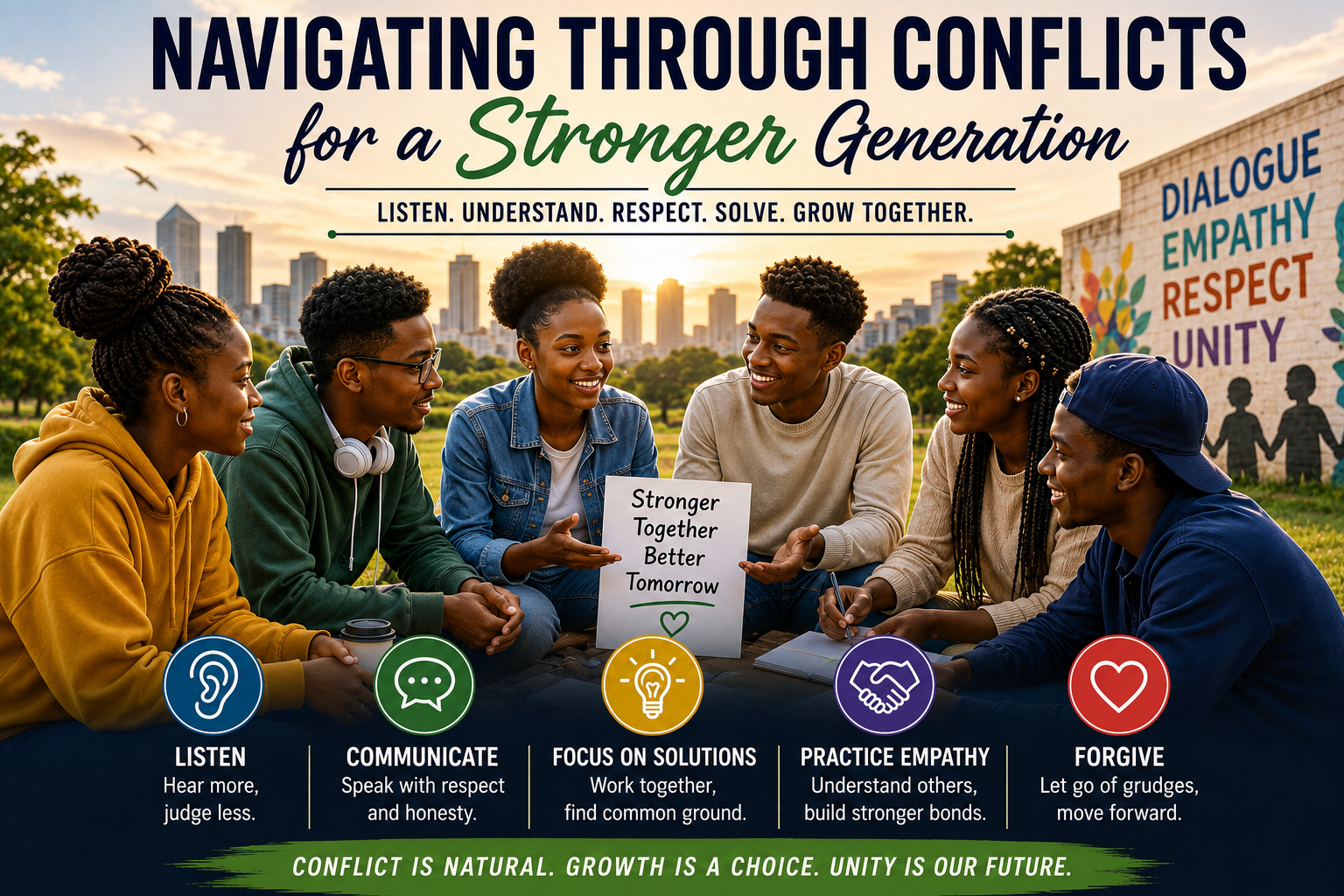
Navigating through conflicts for a stronger generation
Navigating through conflicts for a stronger generation
As a parent today, I often find myself anxiously asking difficult questions. Are our children safe? Are they building healthy friendships? Are they really able to handle disappointment, conflict and competition?
These questions have become even more pressing as we continue to witness heartbreaking incidents involving children and adolescents. In Kenya, we have watched school fires, violent fights between students that have ended in tragedy, and painful cases of children harming or abusing other children. Every new headline leaves many parents shocked and wondering what is happening to our young people.
There is no single answer. The causes are complex and still not clear to many of us, we for sure see increasing changes in family structures, technology, social media, mental health challenges and economic pressures. Yet as I reflect on this, I look back to my own childhood, one lesson continues to stand out. Somewhere along the way, we may have stopped intentionally teaching children how to manage conflict, disagreements and competition.
Growing up, life was different. After school and during weekends, children gathered in open fields, village compounds and estate playgrounds. We played together for hours. Before every game began, we agreed on the rules. We decided who would be on each team, how points would be scored, what counted as a foul and how disagreements would be resolved.
Not every game ended happily. We argued. We disagreed. Some of us lost. Others won. Occasionally someone stormed away in frustration. But we always came back because tomorrow there would be another game and another opportunity to play.
Without realizing it, those moments were teaching us valuable life skills. We were learning negotiation, compromise, teamwork, emotional control and respect for agreed rules. We were learning that losing was disappointing but not the end of the world. We discovered that disagreements could be resolved without violence.
Looking back, those playgrounds were classrooms of life. Conflict management theory tells us that conflict itself is not the problem. The real challenge lies in how people respond to it. The Thomas Kilmann Conflict Mode Instrument identifies five common ways people respond to conflict, competing, avoiding, accommodating, compromising and collaborating. As children, our games naturally taught us compromise and collaboration. We listened to one another, adjusted the rules when necessary and found ways to continue playing together. These are skills that many children today have fewer opportunities to develop naturally.
Another important lesson comes from the work of psychologist Morton Deutsch, whose Theory of Cooperation and Competition explains that when people learn to work together towards shared goals, they are more likely to build trust, empathy and healthy relationships. Our childhood games did exactly that. Winning was important, but maintaining friendships and keeping everyone involved mattered even more.
Today, many of those opportunities and play spaces have disappeared. Open fields have been replaced by buildings. Children spend more time indoors and increasingly interact through screens rather than face to face. Opportunities to solve disagreements naturally through play are becoming fewer. While technology has brought many benefits, it cannot fully replace the social learning that happens when children negotiate rules, resolve disputes and build friendships in real life.
Perhaps it is time to intentionally bring back opportunities for children to play, interact and learn together. This is not simply about sports or recreation. It is about creating environments where children learn cooperation, patience, leadership and conflict resolution in practical ways.
Schools should continue prioritizing academic excellence, but they should also invest in life skills education, peer to peer models and structured play. Parents should create opportunities for children to interact beyond digital devices. Creative ideas like communities organizing neighborhood sports, arts and cultural activities that bring children together while strengthening relationships across generations.
Conflict is part of life. The goal is not to eliminate it. The goal is to teach children how to respond to it constructively.
As we continue searching for answers to the disturbing incidents we see today, let us also remember the simple lessons many of us learnt as children. Sometimes the solutions we seek are not always found in complicated policies. They can begin with restoring spaces where children learn to listen, compromise, lose with dignity, celebrate others and resolve disagreements peacefully.
We have a shared responsibility to today’s children. They are not only the leaders of tomorrow. They are our next generation and caregivers of the future. The values we nurture today will shape the kind of society we live in for generations.
Perhaps the question is no longer what is happening to our children. Perhaps the more important question is what we, as families, schools and communities, are doing to prepare them for life.
The answer may begin with something as simple, and as powerful, as letting children play together again.