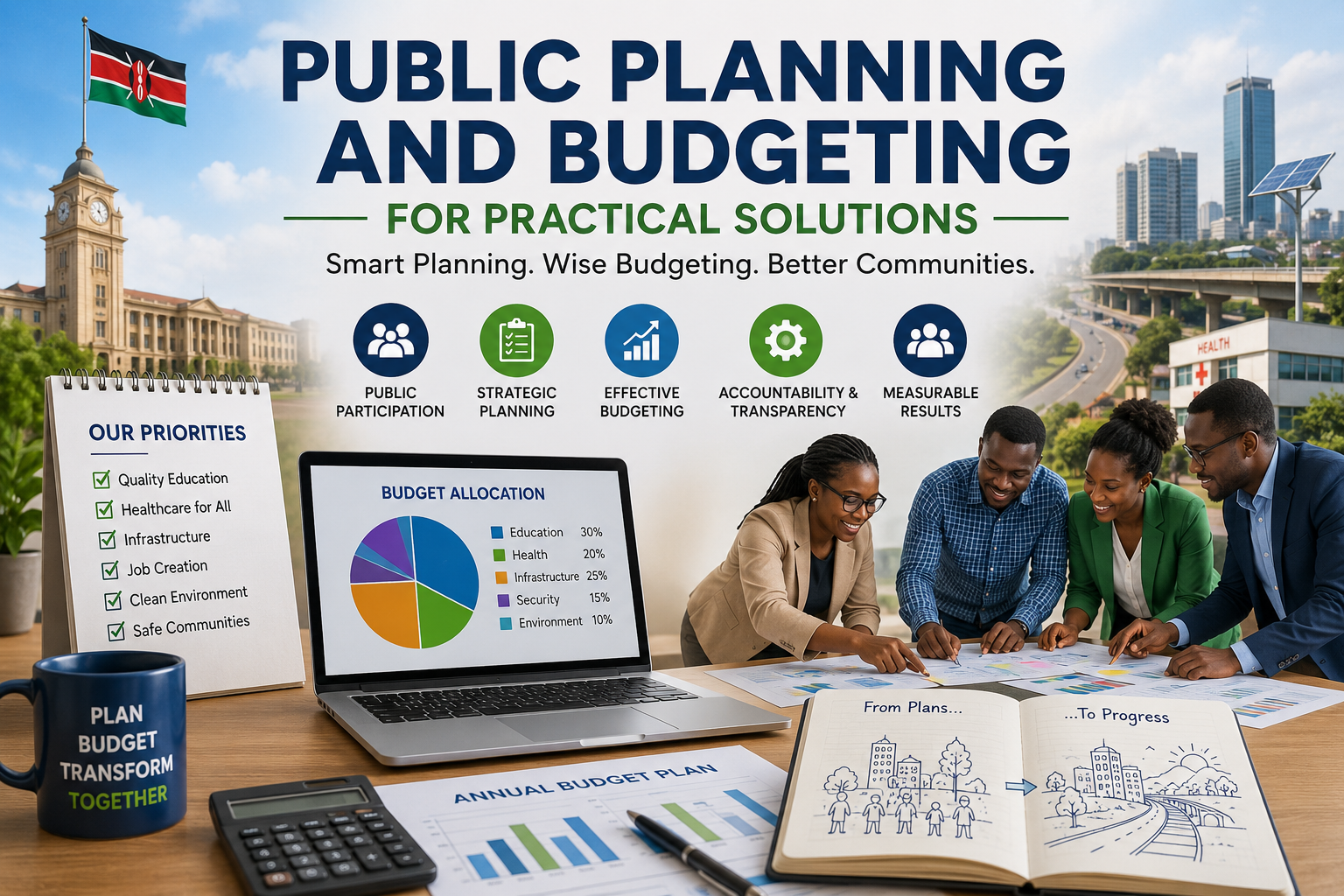
Public Planning and Budgeting for Practical Solutions
Public Planning and Budgeting for Practical Solutions
As countries across Eastern Africa continue with their budget-making processes, I find myself reflecting on a question that has bothered me for years: Why do we continue planning and budgeting for projects that communities do not fully own, while many genuine community priorities remain unresolved?
Most countries in the region operate on a July to June financial year. This means that as governments prepare new budgets, implementation of current projects is still ongoing. It is a season filled with public participation forums, budget estimates, planning meetings, and promises of development.
In Kenya, public participation is one of the greatest gains of our Constitution. Citizens have a chance to share their views on what they need and where public resources should be invested. This is a powerful tool for democracy and accountability.
However, I believe there is still a missing link.
Many are the times, communities are asked what they need, however there is less focus on how those priorities are integrated, coordinated, implemented, monitored, and sustained. As a result, we often end up with fragmented projects, competing priorities, duplication of efforts, and in some cases, abandoned projects that become monuments of wasted public resources.
When I was growing up, I often heard my parents talk about village development committees. Community members would gather in meetings and barazas to discuss local challenges, available resources, and possible solutions. They would agree on priorities, identify who would do what, and continuously follow up on progress.
Those discussions were not perfect, but they created something very important: community ownership.
People knew why a project was being implemented. They understood its value. They participated in monitoring it. Most importantly, they felt responsible for its success.
Today, we have many development actors operating within the same communities. National government projects, county government projects, projects funded through Members of Parliament, Members of County Assembly, development partners, private sector investments, faith-based organizations, and community initiatives all exist within the same geographical areas.
While each actor may have good intentions, the lack of coordination sometimes leads to situations where one village receives multiple projects serving similar purposes while another critical need remains unaddressed. In some cases, projects become associated with individuals rather than communities. Development becomes a branding exercise instead of a solution to community challenges.
Sustainable development requires us to go back to basics.
Before prioritizing projects, communities should undertake comprehensive needs assessments and resource mapping exercises. Resource mapping helps communities identify what they already have. This includes schools, health facilities, water sources, roads, youth groups, women groups, skilled artisans, farmers’ associations, community health promoters, faith-based institutions, and local businesses.
At the same time, communities should identify and rank their most pressing needs.
Let us take a practical example.
Imagine a community identifies four major challenges: lack of clean water, poor roads, youth unemployment, and overcrowded classrooms.
Through a structured prioritization process, community members may determine that access to clean water should be the first priority because it directly affects health, education, productivity, and household incomes. Women and children spend less time searching for water. School attendance improves. Water-borne diseases reduce. Economic activities increase.
A resource mapping exercise may further reveal that the community already has land available for a water project, local artisans capable of supporting construction, an active water users’ association, and development partners willing to contribute technical support.
Instead of starting from zero, the community builds on existing assets and focuses available resources on a priority with the greatest impact.
That is practical planning.
Kenya already has positive examples of what integrated planning can achieve. The expansion of road infrastructure has opened up markets and improved connectivity. The Last Mile Connectivity Programme has increased electricity access to households. Investments in Universal Health Coverage, community health programmes, water projects, school infrastructure, and digital services have improved service delivery for millions of Kenyans.
These successes demonstrate that when governments, communities, development partners, and the private sector work together around a shared vision, meaningful transformation is possible.
As we continue improving our public planning and budgeting systems, I propose several actions.
First, communities should develop integrated development master plans that guide all actors working within a particular area. Development priorities should belong to communities, not individual offices or political leaders.
Second, governments should prioritize completing ongoing projects before launching new ones. Across the country, there are unfinished classrooms, health facilities, water projects, and markets that require completion before additional projects are initiated.
Third, community resource mapping and needs prioritization should become a routine part of planning and budgeting processes. This will ensure decisions are based on evidence and local realities rather than assumptions.
Fourth, communities should be actively involved in monitoring project implementation. Citizens are often the first to notice poor workmanship, delays, or misuse of resources. Their participation strengthens accountability and quality assurance.
Fifth, every project should have a sustainability and transition plan. We must move beyond commissioning projects and ensure communities have the capacity, structures, and resources needed to maintain them over time.
Finally, project appraisal and closure should become standard practice. Communities should assess whether projects achieved intended outcomes, identify lessons learned, and use those lessons to inform future investments.
Development is not measured by the number of projects launched or the size of a budget. It is measured by the lives transformed, opportunities created, and challenges solved.
As we participate in public planning and budgeting processes, let us move beyond merely identifying needs. Let us embrace coordinated planning, resource mapping, community ownership, accountability, and sustainability.
When communities know what they need, understand the resources they already possess, and work together with governments and other stakeholders, development stops being a political promise and becomes a lived reality.
That is the kind of planning and budgeting that delivers practical solutions.