
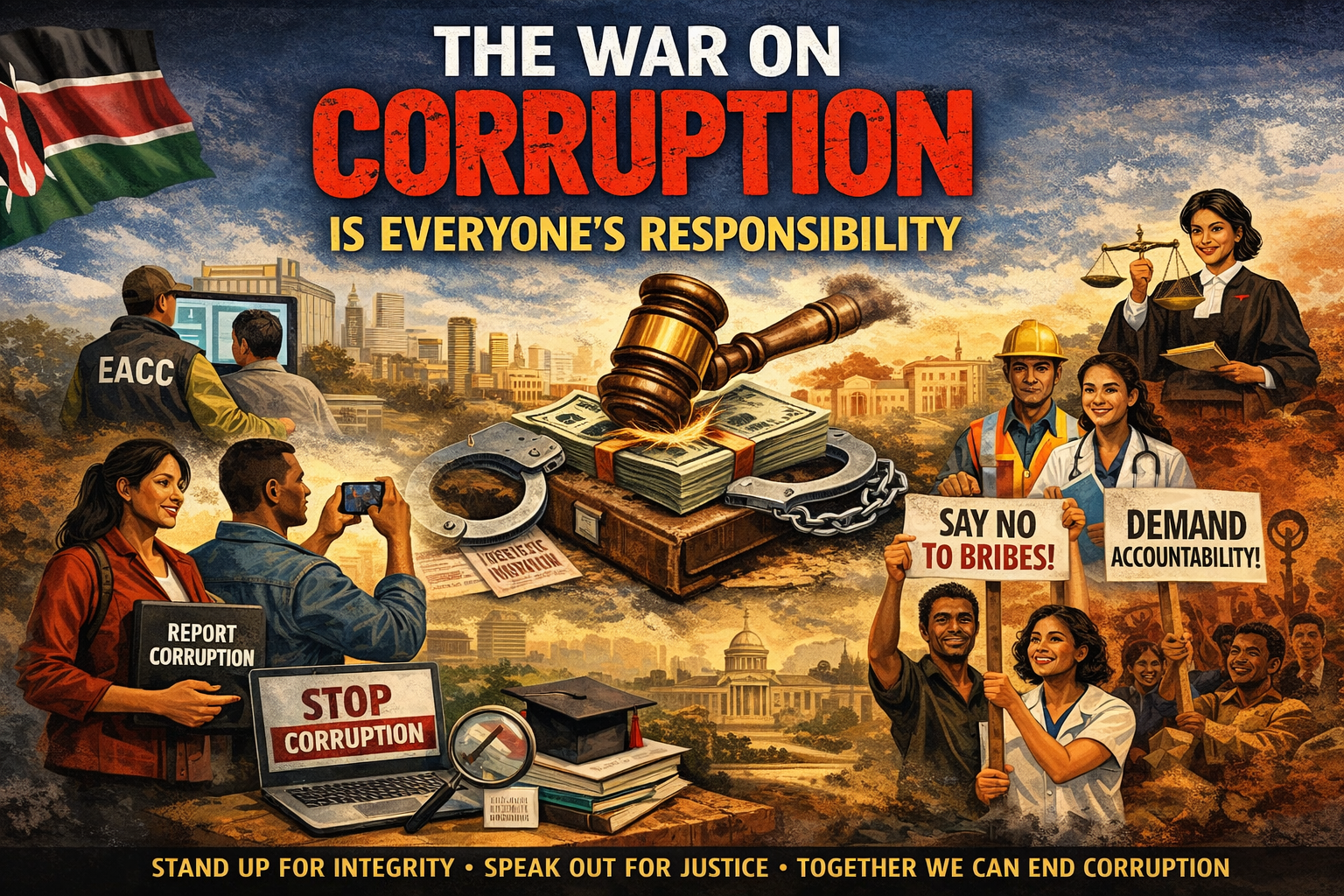
The War on Corruption is Everyone’s Responsibility
The War on Corruption is Everyone’s Responsibility
This month’s release of the Kenya National Gender and Corruption Survey 2025, paints a troubling picture of the state of corruption in our country. According to the findings, an overwhelming 98.6% of Kenyans who paid bribes did not report the incidents with only 1.4% taking the step to report. Among those who did, men accounted for 57.2%, while women made up 42.1%.
Equally striking is the reported average bribe amount of KSh 6,724 a figure that reflects not just the financial burden on citizens, but the normalization of corruption in everyday life.
These numbers should concern all of us. They point to a deeper crisis, a growing culture of silence and an increasing loss of public trust. When only 14.6% of Kenyans believe the government is committed to fighting corruption, it signals a dangerous disconnect between institutions and the people they serve.
Corruption in Kenya is no longer perceived as an isolated vice affecting a few sectors. It has become embedded in daily interactions at service delivery points, in procurement processes, and even in the implementation of public projects. For many citizens, paying a bribe is no longer an exception; it is seen as the only way to get things done.
This normalization is perhaps the greatest threat. It creates a cycle where public officials expect informal payments, and citizens comply out of frustration or necessity. Over time, this erodes the very foundation of public service, turning rights into privileges that must be paid for and sadly creates a culture where corruption is the new normal, a new culture.
However, corruption is not only about money exchanging hands. It also manifests in less visible but equally damaging ways. When funds are allocated to new projects while previously funded ones remain incomplete, that is corruption. When audit reports highlight misuse of resources year after year without action, that is corruption. When public office is used for personal or political gain at the expense of citizens, that too is corruption.
The persistent gap between reporting and action is what fuels public disillusionment. Reports are produced, findings are shared, but consequences are rarely felt. Without visible accountability, citizens lose faith in the system and silence becomes the default response.
If Kenya is to win the war on corruption, it must move beyond documentation to decisive action.
First, there must be consistent and visible accountability. Corruption cases whether high profile or routine must be investigated thoroughly and concluded within reasonable timelines. The recovery of stolen public resources should be prioritized, and those found culpable must face real consequences. Justice must not be selective, and it must not be delayed.
Second, society must confront its own role in sustaining corruption. The tendency to defend individuals accused of corruption simply because they are “one of us” undermines collective progress. Integrity cannot be negotiable. We must reject the culture of excusing wrongdoing based on personal, ethnic, or political affiliations.
Third, there is a need to increase transparency and accountability. Publishing sector-based corruption trends, performance scorecards, and follow-up actions on audit findings can strengthen oversight and public engagement. When citizens are informed, they are better equipped to demand accountability.
Fourth, systemic reforms are critical. Simplifying government processes, strengthening, digitizing services, and reducing unnecessary human interaction in service delivery can significantly limit opportunities for bribery. Technology, when properly implemented, can be a powerful tool in closing corruption loopholes.
Fifth, citizens must be empowered and protected to report corruption. Strengthening whistleblower protection frameworks and ensuring confidentiality in reporting mechanisms can encourage more people to come forward. Equally important is demonstrating that reports lead to action. Without this assurance, reporting will remain low.
Finally, the fight against corruption must be rooted in values. Building a culture of integrity requires sustained effort through education, leadership, and example. Integrity must be practiced at all levels of society, from public offices to households.
The 2025 survey should not be seen as just another report. It is a mirror reflecting the state of our nation. The question is whether we will act on what we see.
The responsibility to end corruption does not lie solely with government institutions. It rests with all of us leaders, citizens, and institutions alike. Each decision we make, whether to demand, give, report, or ignore corruption, shapes the kind of society we become.
Kenya stands at a critical point. Continuing on the current path risks further eroding public trust and undermining development efforts. Choosing a different path one of accountability, transparency, and integrity offers the possibility of rebuilding that trust.
The war on corruption is not won through reports. It is won through action.